What Is Adaptive Learning? How AI Personalises Your Child's Study Plan
A plain-language explanation of adaptive learning — how AI actually personalises a child's study plan, and why "personalised" usually means more than most people assume.
5 min read · Article 08 of 20
"Personalised learning" has become one of those phrases that gets used so often in ed-tech marketing that it's started to mean almost nothing. So let's actually define it properly: what is adaptive learning, how does it genuinely work, and how is it different from just having a nicer app with more colours in it?
The Simple Definition
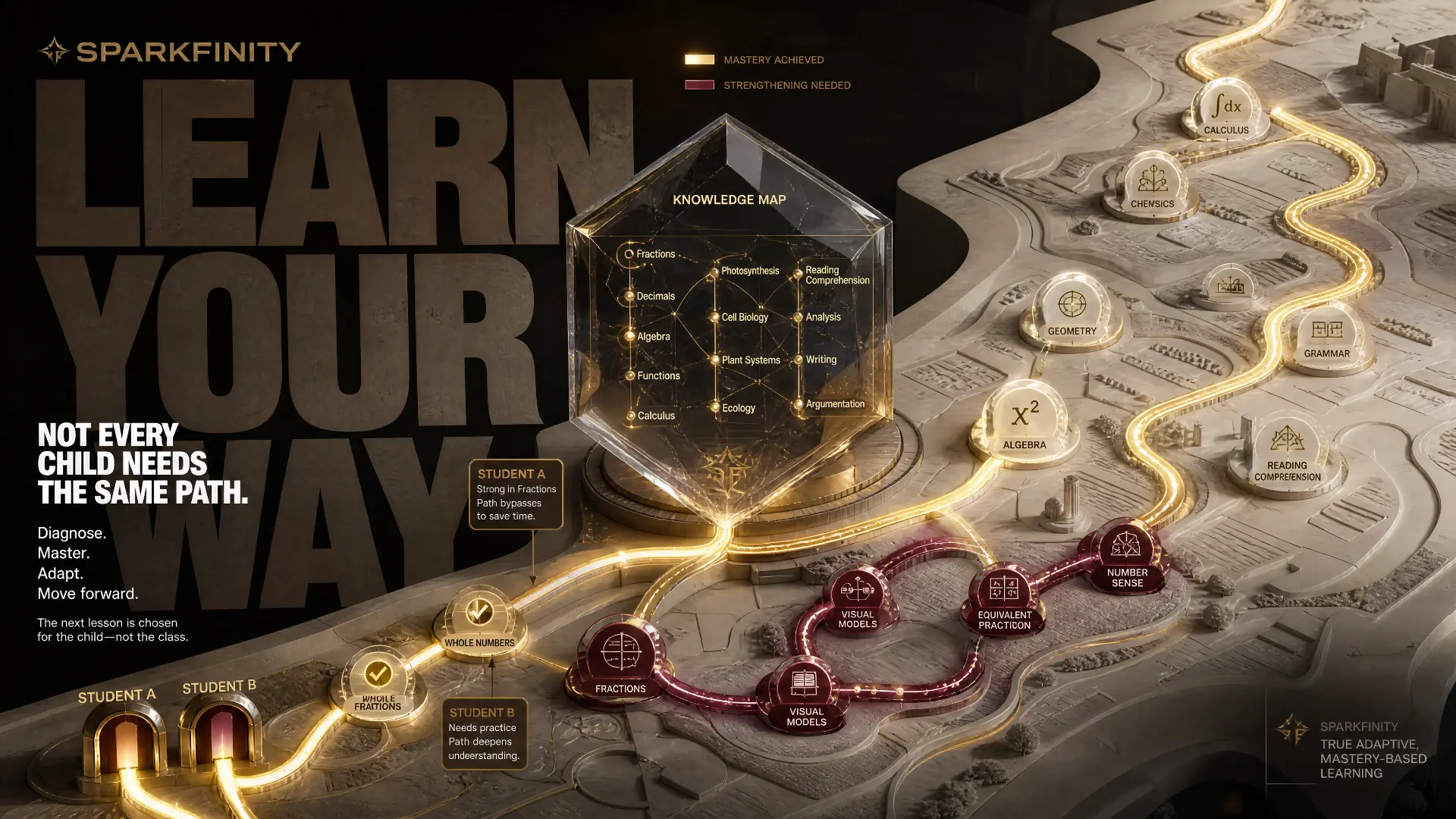
Adaptive learning is a teaching approach where the content, pace, and difficulty a student sees changes based on their own performance — in real time, not just at the start based on a one-time quiz. If a child gets three algebra questions wrong in a row, an adaptive system doesn't just move to the next scheduled topic. It recognises the gap and adjusts — offering a different explanation, easier practice questions to rebuild the foundation, or more repetition specifically on that concept before moving forward.
Traditional study material — a textbook, a printed worksheet, even most recorded video courses — doesn't do this. Every student gets the same sequence, at the same pace, regardless of what they individually understand or struggle with.
How It Actually Works, Step by Step
1. It starts by observing, not assuming. Instead of guessing what a child knows, an adaptive system tracks actual responses — which questions were answered correctly, how quickly, and where hesitation or repeated mistakes show up.
2. It builds a real-time picture of strengths and gaps. This isn't a single test score. It's an ongoing, evolving map — a child might be strong in Geometry but consistently shaky on word problems involving ratios, and the system tracks that at a granular, topic level rather than a subject-wide average.
3. It adjusts what's shown next. Struggling with a concept triggers different content — a different explanation style, easier building-block questions, or more repetition — instead of just pushing forward regardless. Mastering a concept quickly means moving ahead faster, instead of sitting through unnecessary repetition.
4. It resurfaces forgotten material before it's fully forgotten. This is the part most people don't realise is part of adaptive learning — spaced repetition. A concept a child got right two weeks ago quietly reappears in a flashcard or quiz just as it's statistically likely to start fading from memory, reinforcing long-term retention rather than short-term recall.
Why This Matters More Than It Sounds Like It Does
Here's the practical problem adaptive learning solves: two children in the same class, taught by the same teacher, from the same textbook, can walk away with completely different levels of understanding — and a fixed curriculum has no way to notice or correct for that gap in real time. One child needs to hear the fractions explanation three different ways before it clicks. Another understood it the first time and is now bored sitting through repetition they don't need.
A human tutor, at their best, does this instinctively for one child at a time. Adaptive learning technology does it for every child, individually, at scale — including for the child whose parents can't afford or access one-on-one tutoring.
What Adaptive Learning Is Not
It's worth being clear about what this isn't, because the term gets stretched to cover things that don't really qualify:
- It's not just difficulty levels a student picks manually. Letting a student choose "easy, medium, hard" isn't adaptive — it's just a menu. Real adaptive learning adjusts automatically based on demonstrated performance, not self-selection.
- It's not just gamified rewards for correct answers. Points and badges make an app more engaging, but engagement isn't the same as the underlying content actually adjusting to what a child needs.
- It's not a one-time placement test that sets a fixed path. A single diagnostic quiz at the start, followed by a static path, isn't truly adaptive — genuine adaptive learning keeps adjusting continuously as new performance data comes in.
What This Looks Like for a Parent, Practically
The clearest sign an app is genuinely adaptive: two children using it for the same chapter will have visibly different experiences — different questions, different pacing, different flashcards resurfacing — because their actual performance differs. If every child sees exactly the same sequence regardless of how they're doing, it isn't really adaptive, whatever the marketing says.
A Simple Example of Adaptive Learning in Action
Consider two students studying the same Class 9 Science chapter on force and motion. Student A quickly answers questions on Newton's first law correctly but hesitates on numerical problems involving the second law. An adaptive system notices this specific pattern and starts surfacing more second-law numericals, while reducing repetition on the first law, which is already clearly mastered. Student B struggles with both, so the system instead offers a simplified re-explanation of the underlying concept before returning to practice questions at all.
Both students technically "did the same chapter." Their actual experience — what they saw, how often, and in what order — looked completely different, because it was shaped by what each of them individually needed. That's the practical difference adaptive learning makes, beyond the definition.
The Underlying Idea, Restated Simply
If there's one sentence worth remembering from all of this: adaptive learning treats a child's actual performance as the primary input for what happens next, rather than treating the syllabus sequence as the only input. That single shift — from "what chapter comes next" to "what does this specific child need next" — is the entire difference between a fixed curriculum and a genuinely adaptive one.
How Sparkfinity Builds This In
Sparkfinity's flashcards and practice tools are built around genuine adaptive learning — tracking what a child actually gets right, wrong, and hesitates on across every chapter, and adjusting what's shown next accordingly. Combined with AI video lessons that can re-explain a concept differently when the first version didn't land, the goal is a study plan that's shaped by how a specific child learns — not a fixed sequence every child is pushed through identically.
Frequently Asked Questions
Is adaptive learning better than a fixed curriculum for every child? For reinforcement and revision, generally yes — it targets time toward actual gaps rather than spreading effort evenly regardless of need. It works best alongside, not instead of, structured classroom teaching.
Can adaptive learning work for board exam preparation? Yes, and it's particularly useful here — board years require covering a large syllabus efficiently, and adaptive systems help direct revision time toward genuinely weak areas rather than re-covering everything equally.
Does adaptive learning require constant internet access? This depends on the specific platform's design — some require connectivity for real-time adjustment, while others can sync progress periodically. It's worth checking this for a family's specific situation.
How is adaptive learning different from simply hiring a good tutor? A skilled tutor does something similar for one child at a time, based on judgment and experience. Adaptive learning technology does it through tracked data, continuously, and at a scale and consistency a single tutor's schedule can't match.
Next step
Turn this into a plan for your child.
Two live classes a week, an AI tutor that remembers every weak topic, and a weekly parent update in plain language — ₹3,999 a month.
Continue exploring
Everything on Sparkfinity AI is one or two clicks away.
- All 14 FeaturesEvery capability in the Sparkfinity learning system.Open→
- Pricing₹3,999 a month — two live one-hour AI Basics classes each week.Open→
- How It WorksDiagnose, teach, test, retest — the loop behind every class.Open→
- FAQ28 answers on classes, safety, syllabus and pricing.Open→
- Contact UsTalk to us on WhatsApp, phone or email and book a seat.Open→