AI Tutors vs Human Tuition: What Actually Helps Kids Learn Faster in 2026?
An honest comparison of AI tutoring and traditional human tuition — where each genuinely helps, where each falls short, and what actually works best for most kids.
5 min read · Article 06 of 20
This isn't a question with a clean, one-sided answer, and any article that pretends otherwise is selling you something. AI tutoring and human tuition solve different parts of the same problem, and the honest comparison is about where each one genuinely helps a child learn faster — not which one "wins."
What Human Tuition Has Always Done Well
Good human tutors bring things that are genuinely hard to replicate: emotional read of a struggling child, the ability to notice frustration before it becomes avoidance, and real-time adaptation based on a raised eyebrow or a hesitant answer. A great tutor doesn't just explain a concept — they notice how a specific child is misunderstanding it and adjust on the spot.
The honest limitations are structural, not personal. A tutor can only be in one place, teaching one student or a small group, at one pace, for a fixed number of hours a week. Quality varies significantly between tutors. And a child's shakiest moment — 9 p.m., stuck on a homework problem, tutor unavailable until the next scheduled session — often goes unaddressed until it's compounded into a bigger gap.
What AI Tutoring Actually Does Well
The strongest, most honest case for AI tutoring isn't "it's smarter than a human." It's availability, patience, and personalisation at a scale no human tutor can match.
- It's available at 9 p.m. on a Tuesday, when the homework question actually comes up — not three days later at the next scheduled session.
- It never gets impatient with the fifth "wait, explain that again," which matters enormously for kids who are self-conscious about asking questions repeatedly in front of a person.
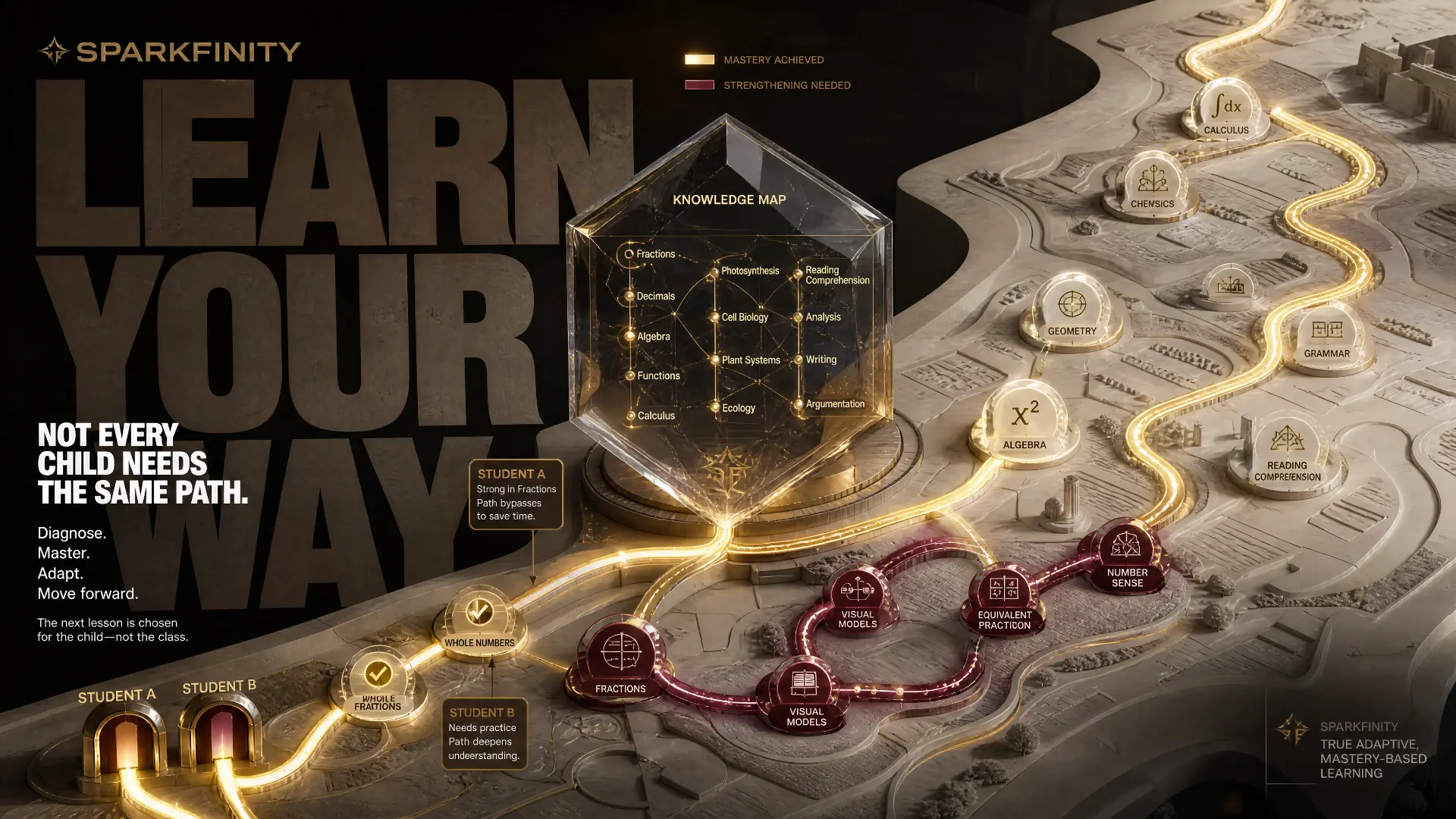
- It adapts based on data, not impressions — genuinely tracking which concepts a specific child struggles with across weeks, and resurfacing exactly those, rather than relying on a tutor's memory of last month's session.
- It's consistent — the same quality of explanation every single time, not dependent on which tutor is available that week.
Where AI tutoring is honestly weaker: it doesn't (yet) replace the emotional attunement of a trusted adult noticing a child is anxious, not just confused — and it can't replace the motivational push a caring human sometimes provides at exactly the right moment.
The Real Question Isn't "Which One" — It's "Which One, For What"
Framing this as AI versus tuition misses how most families actually use both today. The more useful question is: which parts of learning genuinely benefit from human judgment, and which parts genuinely benefit from patient, data-driven repetition and availability?
Best suited to AI-led learning:
- Daily concept reinforcement and revision
- Practicing a skill until it's genuinely automatic (times tables, grammar rules, formula application)
- Late-evening or weekend doubt-clearing when a tutor isn't available
- Adaptive flashcards that resurface exactly what a child is forgetting, based on actual performance data
Best suited to human involvement:
- Motivation and emotional support during genuinely stressful periods (like board exam months)
- Complex, open-ended discussion — essay feedback, project guidance, career conversations
- Noticing non-academic issues (anxiety, disengagement) that show up as academic struggles
What the Research and Real-World Data Actually Suggest
Independent of any single product's marketing, a consistent pattern shows up in education research: personalised, adaptive practice — delivered consistently and frequently — improves retention and mastery more reliably than infrequent, high-quality-but-irregular sessions alone. This isn't an argument against tuition. It's an argument for pairing infrequent human guidance with consistent daily reinforcement, which is exactly the gap AI-led learning is well suited to fill.
A Word on Cost and Access
It's worth naming a practical reality directly: high-quality human tuition, especially one-on-one, is genuinely expensive and not equally accessible to every family, regardless of a child's need for it. AI-led learning tools generally cost a fraction of comparable human tutoring time, which means the "consistent, personalised support" described throughout this article isn't limited to families who can afford premium tutoring — it becomes available at a meaningfully lower cost, which matters enormously at scale across Indian households with very different budgets.
A Practical Way to Combine Both
For families who already have a tutor or are considering one, the most effective combination usually looks something like this: human tuition sessions focus on the things they're genuinely best at — explaining new, difficult concepts for the first time, motivational check-ins, and open-ended discussion — while AI-led tools handle daily reinforcement, doubt-clearing between sessions, and spaced revision that keeps earlier material from fading.
This isn't about splitting hours evenly. It's about matching each tool to what it's genuinely strongest at, rather than expecting either one to cover the full range of what a child needs on its own.
Where This Actually Lands for a Parent Deciding Today
If the goal is board exam performance, genuine long-term retention, and reducing the daily friction of "getting a child to sit down and revise," AI-led learning tools deserve a real place in the routine — not as a replacement for a good tutor or teacher, but as the daily layer that makes everything else more effective. Kids don't fall behind because one tuition session was missed. They fall behind because there's no consistent, low-friction way to reinforce learning between sessions — and that's precisely the gap.
How Sparkfinity Fits Into This Picture
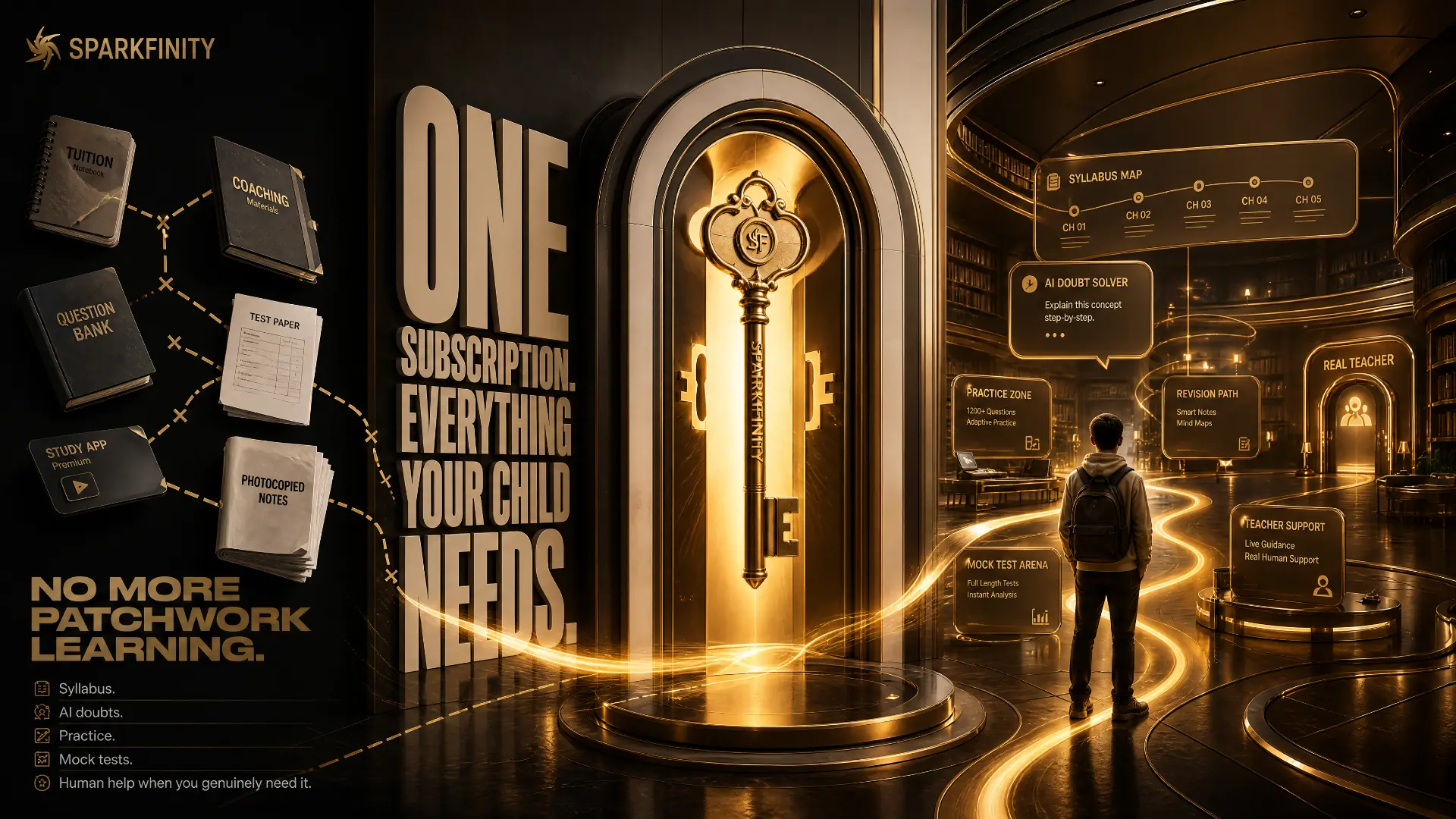
Sparkfinity isn't built to replace a child's school or their tutor. It's built to be the AI teacher for the syllabus itself — cinematic AI video lessons, a patient AI voice tutor for doubts, adaptive flashcards, and notebook-style tools — so that the daily, consistent layer of learning is finally covered, whatever else a family already has in place. AI is the teacher here. Not the subject a child has to separately learn about.
Frequently Asked Questions
Can AI tutoring fully replace human tuition? Not entirely, and it isn't trying to — human tutors provide emotional support and nuanced judgment that AI doesn't replicate. AI tutoring is strongest as a consistent daily layer alongside, not instead of, human guidance.
Is AI tutoring effective for younger children (Grades 1–5)? Yes, particularly for building foundational habits and consistent practice, though younger children generally still benefit from parental involvement in guiding how and when they use it.
Does AI-led learning work for board exam years specifically? It works especially well here, since board years need heavy, consistent revision and doubt-clearing — exactly the kind of repetitive, patient support AI tools are well suited to provide at scale.
Is AI tutoring more affordable than traditional tuition? Generally yes, since it removes the cost structure tied to one-on-one or small-group human time, making consistent, personalised support accessible at a fraction of typical tuition costs.
Next step
Turn this into a plan for your child.
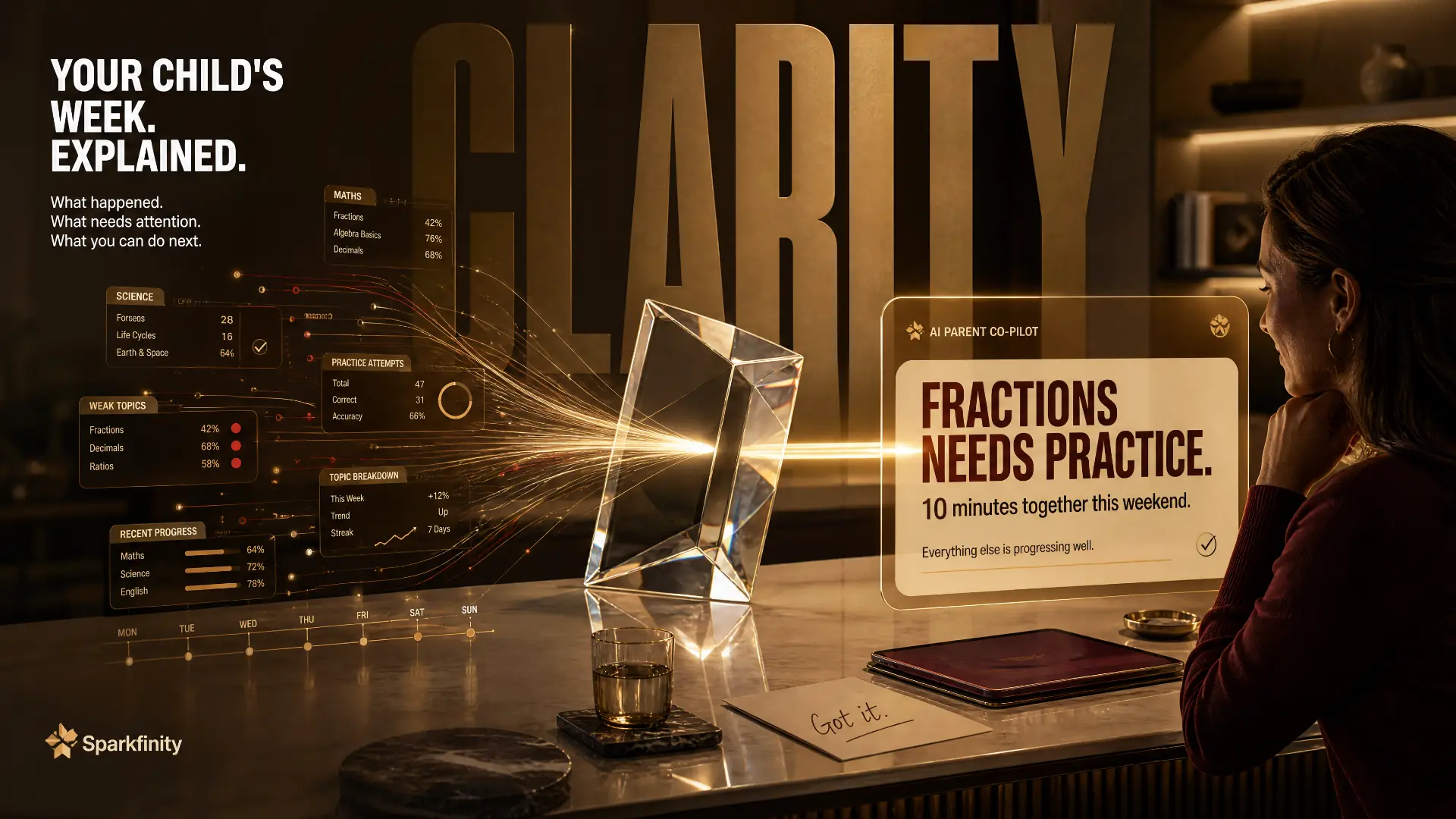
Two live classes a week, an AI tutor that remembers every weak topic, and a weekly parent update in plain language — ₹3,999 a month.
Continue exploring
Everything on Sparkfinity AI is one or two clicks away.
- All 14 FeaturesEvery capability in the Sparkfinity learning system.Open→
- Pricing₹3,999 a month — two live one-hour AI Basics classes each week.Open→
- How It WorksDiagnose, teach, test, retest — the loop behind every class.Open→
- FAQ28 answers on classes, safety, syllabus and pricing.Open→
- Contact UsTalk to us on WhatsApp, phone or email and book a seat.Open→