How AI-Powered Learning Apps Are Changing the Way Indian Kids Study
A look at how AI-powered learning apps are reshaping study habits for Indian students — beyond the hype, what's genuinely different for kids and parents.
5 min read · Article 07 of 20
Walk into most Indian homes with a school-going child today and you'll find some version of the same scene from a decade ago: a stack of notebooks, a set of reference guides, maybe a tuition schedule pinned to the fridge. What's quietly changed underneath that familiar picture is what fills the gaps between school and tuition — and increasingly, that gap is being filled by AI-powered learning apps.
This isn't a story about replacing schools or teachers. It's a story about what happens when the hours a child spends studying alone — after school, before tuition, on a Sunday afternoon — stop being unguided.
The Problem AI Learning Apps Are Actually Solving
For years, the structure of Indian education outside the classroom hasn't changed much: textbooks, guidebooks, and tuition for those who could afford it. The gaps in this system were always the same — a child stuck on a doubt at 9 p.m. with no one to ask, revision that meant re-reading the same notes for the fifth time, and no real way to know what a specific child was actually struggling with versus what they'd simply memorised for a test.
AI-powered learning apps target exactly these gaps: availability outside school hours, personalisation based on actual performance rather than a one-size-fits-all worksheet, and a shift from passive re-reading toward active, tracked practice.
What's Genuinely Different — Not Just Marketing
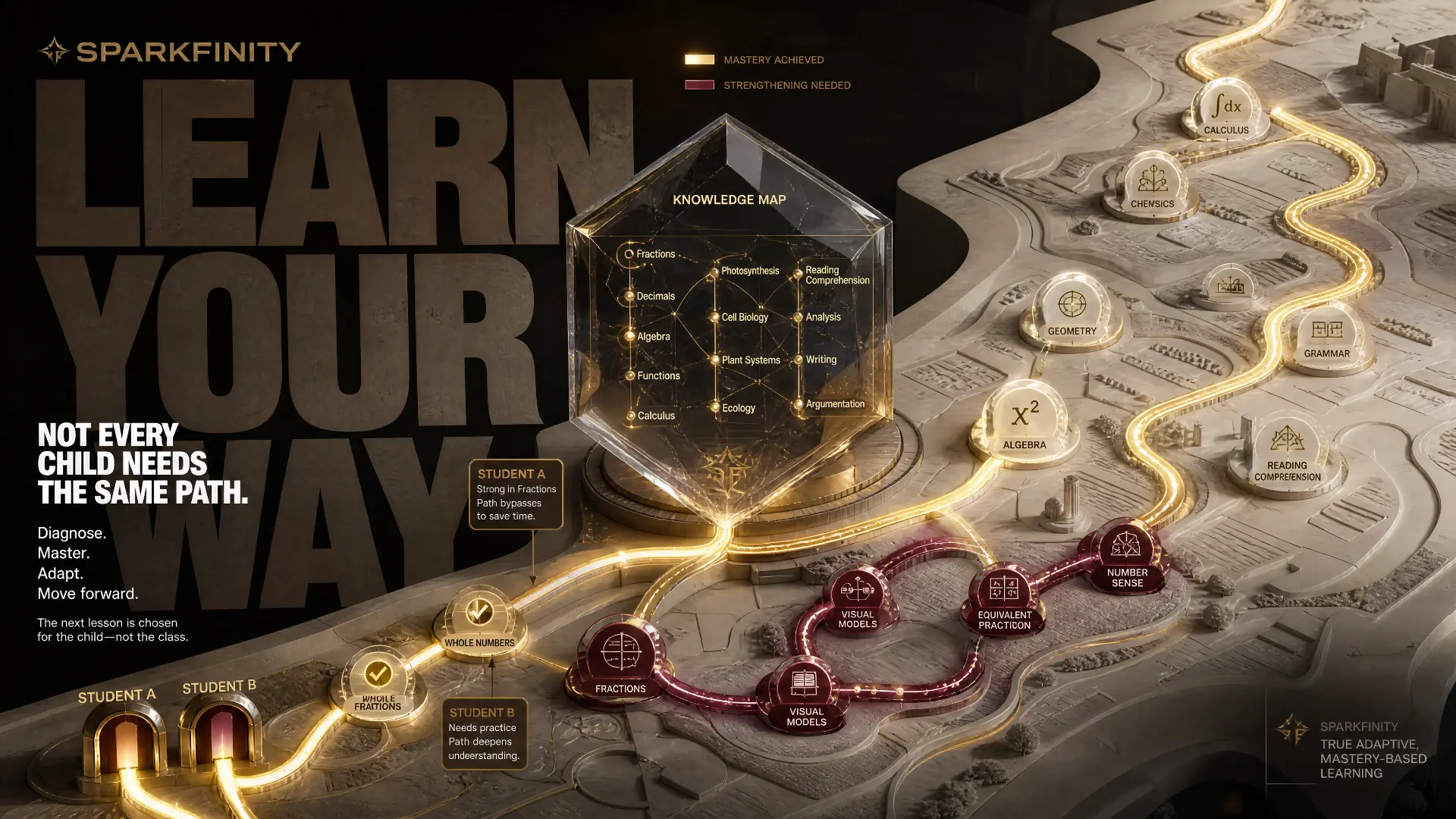
Learning adapts to the child, not the other way around. Traditional study material is static — every child gets the same worksheet regardless of what they already know. AI-powered tools track what a specific child gets right, wrong, and hesitates on, and adjust what's shown next accordingly. A child who's already solid on fractions doesn't need to keep re-practicing them while their algebra gap goes unaddressed.
Concepts get explained in more than one way, automatically. A textbook explains a concept once, in one format. When a child doesn't understand it that way, there's often no built-in alternative. AI-taught video lessons, voice tutors, and interactive simulations can approach the same concept from a completely different angle — visual instead of textual, example-driven instead of definition-driven — without a parent needing to search for a second resource.
Doubt-clearing isn't limited by anyone's availability. This is arguably the single biggest practical shift. A child stuck on a Science doubt no longer has to wait until the next school day or tuition session — an AI tutor is available in the moment the doubt actually occurs, which is exactly when clarifying it matters most.
Progress becomes visible, not assumed. Parents have historically relied on test scores — a lagging indicator — to know if a child is struggling. AI-powered platforms increasingly surface why a score was low, down to specific concepts, well before the next test makes it obvious.
Where This Matters Most for Indian Families Specifically
India's education landscape has unique pressures that make this shift particularly meaningful: large class sizes that limit individual teacher attention, syllabus depth that increases sharply from Class 8 onward, and a tuition culture that, while valuable, is often expensive, schedule-rigid, and unevenly accessible depending on geography and income. AI-powered learning apps don't solve every part of this — but they meaningfully lower the barrier to consistent, personalised support for families who couldn't previously access it at scale.
What Parents Should Actually Look For
Not all "AI learning apps" mean the same thing, and it's worth being a discerning buyer here:
- Does it teach the actual school syllabus, chapter by chapter, or is it a generic skill-building app unrelated to what's being tested in class?
- Does it adapt based on real performance data, or does every child see the same fixed content regardless of what they already know?
- Is there genuine doubt-clearing support, or just pre-recorded videos with no way to ask a follow-up question?
- Does it build long-term retention, through spaced revision and flashcards, or just short-term engagement through gamification alone?
The apps that genuinely move the needle answer "yes" to the first three. Engagement without retention is just a more entertaining way to forget things slightly slower.
How This Trend Is Likely to Keep Evolving
It's worth noting this isn't a passing trend confined to a single product cycle. As AI models get better at explaining concepts in genuinely adaptive, contextual ways — rather than delivering the same fixed video to every student — the gap between "using an app" and "having a personal AI teacher for the actual syllabus" continues to narrow. For Indian families specifically, this matters enormously: it's one of the few shifts in education that historically expensive, one-on-one personalisation is becoming accessible at a fraction of the cost, regardless of geography or income level.
A Generational Shift in How "Studying at Home" Looks
For context, it's worth pausing on how much this has genuinely shifted in a relatively short time. A decade ago, "studying at home" for most Indian students meant a textbook, a notebook, and perhaps a guidebook with solved examples. Today, for a growing number of families, it increasingly means an interactive lesson that adapts mid-session, a voice tutor answering a follow-up doubt in real time, and a flashcard deck that already knows which topic to bring back tomorrow. The tools changed quietly, in the background of ordinary homework routines — which is part of why the shift is easy to underestimate until you look at it directly, chapter by chapter.
What This Looks Like for Sparkfinity
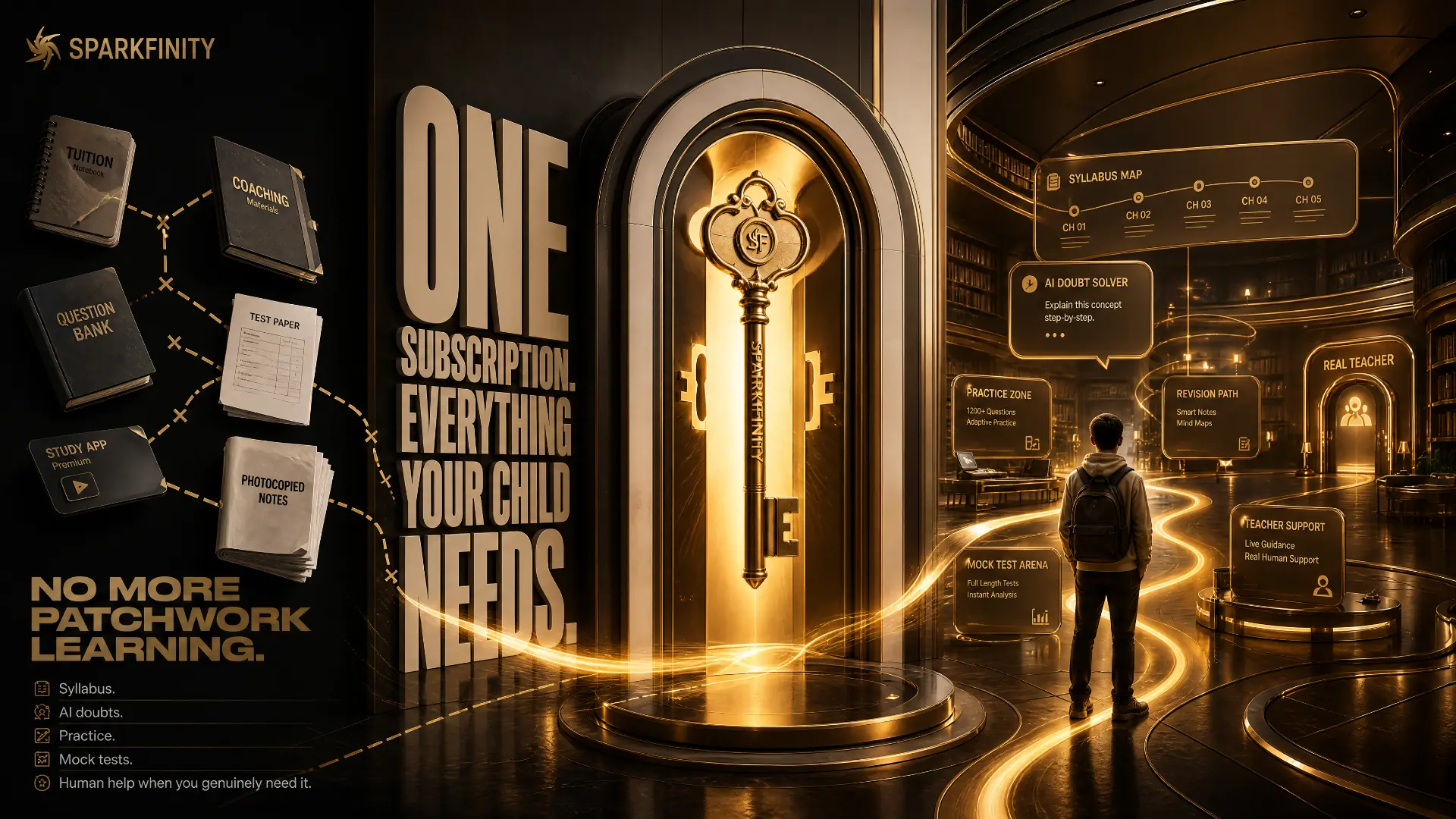
Sparkfinity was built directly around these gaps — teaching a child's actual CBSE or state board syllabus through AI video lessons, an AI voice tutor for doubts whenever they come up, and adaptive flashcards that track and resurface exactly what a child is forgetting. The goal was never to teach kids about AI. It's AI teaching them Maths, Science, English, and Social Studies — the subjects that actually show up on their report card.
Frequently Asked Questions
Are AI learning apps a replacement for school? No — they're designed to support and reinforce what's taught in school and tuition, filling the gap of consistent, personalised practice and doubt-clearing outside class hours.
At what age can a child start using AI-powered learning tools? Most are designed for school-going children from around Grade 1 through Grade 10, though the format (video-led vs. more independent tools) should match the child's age and reading ability.
Do AI learning apps work for both CBSE and state board students? Well-designed platforms map their content directly to a student's specific board and grade syllabus, so the answer depends on the specific app — it's worth confirming this before choosing one.
Is screen-based AI learning bad for kids? It depends heavily on content quality and time management, not screen time alone — focused, syllabus-aligned learning content is a very different use of screen time than passive entertainment, and most concerns around screen time relate to the latter.
Next step
Turn this into a plan for your child.
Two live classes a week, an AI tutor that remembers every weak topic, and a weekly parent update in plain language — ₹3,999 a month.
Continue exploring
Everything on Sparkfinity AI is one or two clicks away.
- All 14 FeaturesEvery capability in the Sparkfinity learning system.Open→
- Pricing₹3,999 a month — two live one-hour AI Basics classes each week.Open→
- How It WorksDiagnose, teach, test, retest — the loop behind every class.Open→
- FAQ28 answers on classes, safety, syllabus and pricing.Open→
- Contact UsTalk to us on WhatsApp, phone or email and book a seat.Open→